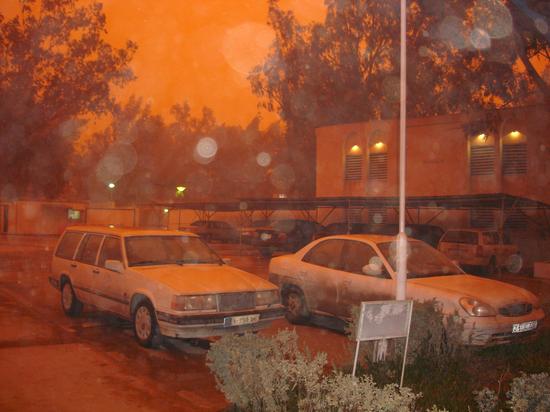
Originally written on Sunday 19, March 2006.
….. red sky in the morning, shephards warning, or so it goes.
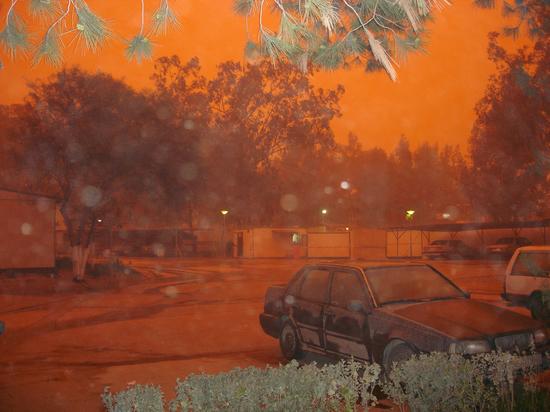
These pictures were taken by a colleague in Tripoli, mid Feb 2006. I was not in Tripoli at the time, so I can only go on eye witness reports. But, as the story goes, there was a tremendous wind blowing in from the south, and it brought with it great clouds of sand, rich, red, fine sand direct from the Sahara.
These pictures are as it was, they have not been touched up anyway, and some say, they don’t really do it justice…. but even so, fantastic colours.
I’ve lifted this from the BBC to try an explain what may have caused it.
“In the Eastern Mediterranean the wind that blows out from Libya and Egypt is known as the Khamsin.
If you dream of lazy summer days spent by the Mediterranean, spare a thought for the people that live there all the year round. The weather is not always as pleasant.
The Mediterranean climate has long dry sunny warm summers, and the winters often see periods of intense rainfall. However, it is in the changeover period of late winter to spring that can have some of the most dramatic weather of all.
In the eastern Mediterranean a wind blows out from Libya and Egypt, known as the Khamsin. This is a wind that is hated by the people living there and indeed in the centuries passed was dreaded as a killer.
During the period February to June depressions can move eastwards along the southern parts of the Mediterranean, or along the North African coast. These can trigger the onset of the Khamsin wind.
Ahead of these low pressure areas the wind blows from the south or southeast off the hot Saharan desert. The temperature can be in excess of 40°C, 104°F, and to make things worse the humidity is very low. So as this wind blows across Libya, Egypt and as far east as Saudi Arabia, it desiccates or dries up everything in its path.
The Khamsin also carries large amounts of sand and dust making the sun go a deep orange, which gives a very eerie feeling to those living there with frequent blasting sandstorms.
The name Khamsin is derived from the Arabic word for 50, which generally refers to the fact that this local Saharan wind blows for about 50 days every year.
In ‘Khamsin’ by Clinton Scollard he says about the wind,
‘It blasted the buds on the almond bough,
And shrivelled the fruit on the orange tree’
‘The tiny fledgling died in the nest;
The sick babe gasped at the mother’s breast.
Then a rumour rose and swelled and spread
From a tremulous whisper, faint and vague,
Till it burst in a terrible cry of dread,
The plague, the plague, the plague.
Oh the wind, Khamsin,
The scourge from the desert, blew in’”