
For the last few years there has been a quiet conversation on going about internet safety, internet privacy and the impact of social media on children. This has, in some ways, been driven by children as young as six being given smart phones by their parents to access applications such as Twitter / X, Facebook, Instergram, amongst others. The risk levels have increased as grot shovellers Grok, owned by Nazi impersonator Musk , Copilot, ChatGTP, Google Gemini and Facebook force users into AI Slop in everything they do.
At the time of writing, late February 2026, Facebook have signed a $60 billion deal with AMD for AI hardware and Data Centre equipment. They will want their money back from somebody.#
On the coat tails of this American onslaught on society and civility politician across Europe, across all flavours, have been pondering Internet Age Verification for Children, to prevent those under a given age, 14 through to 18, do not have the opportunity to see things they should not.
Social Media platforms and AI sewer pipes are not the only areas of contention; chat providers and by extension email and increasing, VPNs are becoming areas of discussion for age verification.
Age verification, for the sake of child safety. That is the core part of the discussion, the core of the story. This is where the lines of conversation become blurred. The story from politicos is that everybody who uses one or more of these platforms, these services, need to verify their age, to prove that they are not children.
Requiring people to verify their age through methods like facial recognition or by registering with an official ID does make it harder for children to access restricted content, but it also prevents anyone from using the web anonymously, particularly now that age verification is being required for more and more services. It is highly problematic that these invasive forms of verification infringe on everyone’s privacy, increase the risk of online surveillance, and could end anonymity online.
Focusing on the EU,
The Digital Services Act (DSA) requires very large online platforms to ask users for age verification checks where needed to mitigate risks to minors. A simple self-declaration, for instance “I am 18” is not sufficient for site with adult content such as pornography, extreme violence, and similar material. Yet, member states of the European Union can impose stricter national rules, and some already have. Let’s break it down!
Italy
- Italy requires mandatory age verification for adult websites (pornography and other 18+ content).
- Adult websites are not allowed to promote VPNs as a workaround.
France
- Adult websites must implement age verification via ID-check or an equivalent system.
- Non-compliant websites can be blocked at the ISP level.
- Several large adult platforms temporarily withdrew from the French market to protest against this law.
- Since beginning of 2026, France is discussing age verification for social media similar to what Australia did in December 2025.
Germany
- In Germany, the requirement for age verification for pornography and similar online content has been there for years.
- Age checks via simply ticking a box that someone is “above 18” are not sufficient for such websites.
- German ruling parties CDU, and now also the SPD, are in favor of banning minors from social media. A decision, however, is postponed until mid of 2026.
Spain
- Spain requires age-verification mechanisms for explicit adult content, such as porn.
- Spain is developing a national digital identity tool to do these age verification checks.
- Spain announced plans to ban social media apps for kids and teens similar to the Australian legislation that is already in place.
Slovenia
- Slovenia is currently drafting a law that would ban children under the age of 15 from accessing social media.
Poland
- Poland want to launch a tool by the end of 2026 so that children can no longer access social media platforms.
Netherlands
- The new Dutch minority government wants under 15-year olds banned from social media, but it goes further than most countries: The Netherlands not only plans such laws for itself, but it also pushes for a similar regulation on EU level.
Portugal
- Portugal’s parliament has approved a law that will ban under 16-year old from accessing social media sites. But children above the age of 13 should be able to use social media with “verified parental consent”.
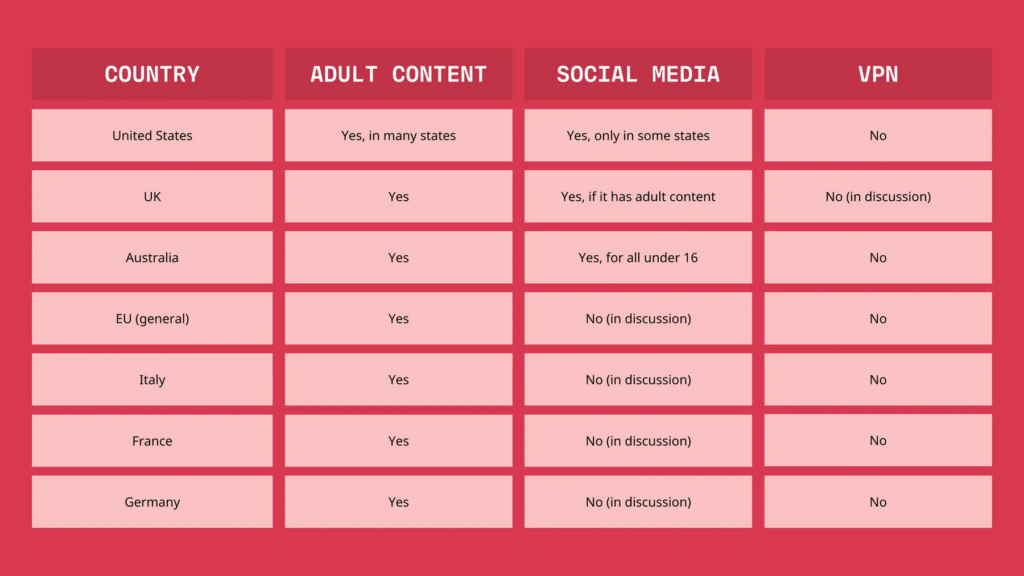
The main contention, the central question, or questions can be laid out fairly simply….
- Should be parents be accountable for their child’s on line safety or should all of society be made accountable ?
- How and by whom will Verification be managed ?
- Will each platform manage verification differently ?
- Will the verification data be stored / located in country or will the data be located in non trusted countries, such as America, or Saudi Arabia ?
Famously, Australia introduced age verification not only for pornography and online gambling, but it was one of the first Western countries that uses age verification to block minors from using social media completely. On December 10 2025, an Australian age verification law enforced that major social media platforms like Facebook, Instagram, TikTok, Twitter / X, YouTube, Snapchat, Reddit, Threads, Twitch, and Kick, have to block under-16s from having an account.
The scope of the law can be increased to search engines and other sites to make sure minors do not get in touch with age-restricted content such as pornography or self-harm.
It remains to be seen how effective it will be.
The EU is pushing ahead with some level of Age Verification. It is also hoping to tie that together with Chat Control, the misguided assumption that end to end encryption can have a ‘back door’ and that, somehow chat content, can be both open to read by Government and secure through encryption. It can’t of course. Only an idiot or a politician would think it could.
But more of that another time.
Leave a Reply