It is not very often that I do a restaurant review, partly because I never read other people’s reviews, partly because they’re often rather fatuous and have the word Instagram in there somewhere and partly because I am not that self obsessed that I think other people really care what I am eating.
Despite that, I am going to offer you this review, or more accurately, this opinion piece.
There are parts of London where one can find sometimes good food, often pretentious food, often expensive food and on a few occasions, combinations of all three. The millennials and hipsters who frequent the over photographed eateries of Shoreditch will understand this.
The Kings Cross area of London could not be further from Scooterville, oft immortalised by Le Carre for the 70’s seediness of the trench coated underworld of Circus operatives, old world chique of run down Victorian buildings and now over crowded with too many cars and lost, bedraggled tourists wondering how to get to the V and A.
Burger restaurants, kebab outlets and sandwich shops are intermingled with coffee shops, both chains and so called independents, serving coffee with mountains of cream, sauces and sprinkles that the average drink now contains as many calories as an average meal from the 1970’s.
 But take a short walk from Kings Cross, past the Acting and Drama schools, the taxi ranks and the International Language schools and the plethora of value dinning experiences and you will find yourself stood outside of an innocuous, low rent looking Japanese restaurant. Look again and you will probably find it is full. If it is evening you will probably be told they have a table free in a couple of hours, or perhaps, tomorrow. If that is the case, you have found the correct place, you have found the Japanese vegan restaurant Itadakizen.
I know this may sound lie an oxymoron but that is what makes this little, busy restaurant such a delight.
In 2013, washoku, or traditional Japanese food, joined UNESCO’s Intangible Cultural Heritage list. The roots of this culinary art lie in the Edo period. Spanning 1603 to 1868, Japan’s Edo period was a time of peace, economic growth, and innovation in the arts, fashion, literature and food. It also was a time of isolation, when Japan largely closed its borders to foreign trade, forcing residents to adopt sustainable approaches to food production and consumption. With its one million residents, Edo, now better known as Tokyo, has a population of around 10 million, drove the nation’s culinary transformation.

Itadakizen has taken this tradition to its next logical, sustainable step; vegan food.
To quote directly from their website,
Why are alternative, more natural methods of cure and prevention regaining popularity in modern society?For thousands of years the medicinal value of plants and food (food as medicine) has been appreciated in Far Eastern tradition.What you eat not only affects your day-to-day health but also helps to determine the quality of your life.Moreover the Itadaki-zener believes that food is closely related to human consciousness as well as human body.Itadaki means ‘to take the food life’; Zen means ‘to fix, to mend’. The primary end of the Itadaki-zen cuisine is not merely an agreeable taste, but its healing qualities.
The Itadaki-zen restaurant was born from the need to provide those who are strong advocates of taking responsibility for their own health and preventing as much illness as possible with a source of food as medicine. In Itadaki-zen cuisine it is essential to eat a good balance of grains, vegetables and seaweeds. This will enable you to build a balance, healthy and slim body.
Rice, root vegetables, seaweeds, soya beans and by-products, are recurrent ingredients in our cuisine because deemed to be essential for a sanitary and strong metabolism.“Slow food” characterizes the cuisine preparation, reflecting appreciation and care in the making of each dish. Anyone who ever thought that vegan meals were dull will be proved wrong by these dishes
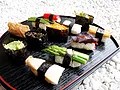 The food itself, when it arrives, is utterly delicious. Apart from the visual sight of not having dead fish on a plate, one would be hard pressed to notice that this was vegan food. The flavours are fresh and singular; individual dishes have their own flavours which can be mixed and blended with others as you see fit. A bento box is, as the name suggests, a number of small dishes served in a segregated box. It is up to you, to dip it in the soy, or add the ginger, swirl it in the Yangyeom sauce or, if you dare, take it al fresco.
 I have eaten at Itadakizen a number of times and have never yet been disappointed; other than not being able to try more. Rice is surprisingly filling. Add to that seven pieces Tempura in the Tempura basket, some Kimpab and a bowl of miso and one has a meal fit for a king. Or, this being a Japanese restaurant, an Emperor.
All the images are lifted directly from their own website, here.
 Mark Daniels