Over the last weeks and moths we have been reading about the progress of AI, or Artificial Intelligence and how it will help / destroy / save humanity. As recently as yesterday the BBC published an article that states Googles claims that its own AI offering can now make telephone calls on your behalf and manage simple tasks, whilst interacting with real humans.
Its claims are not verified, this, after all, was a press conference from Google, who played a recording of the interaction, arranging a simple hair appointment. From the recording, all is well.
During January 2016 the BBC’s Infinite Monkey Cage had an episode discussing AI, with neuroscientist Anil Seth, and robotics expert Alan Winfield. The programme was 40 minutes long and I am not gong to be provide a précis here, however I would recommend downloading and listening. It was very interesting.
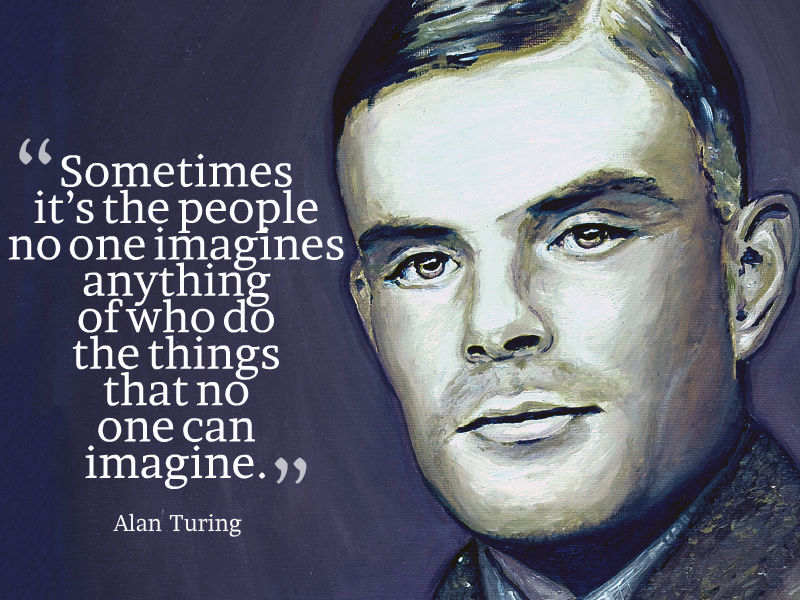
One of the topics covered was the Turing Test, developed during 1950 whilst he was working at the University of Manchester. In Turing’s ground breaking paper Computing Machinery and Intelligence, which can be read here, Turing’s opening lines were “I propose to consider the question, “Can machines think?”.” Turing considers that this is too stark a question in an intuitive, human world and proposes a new scenario, which he calls the Imitation Game, during which there is a written conversation between two humans. At some point, one of the humans is substituted for some machine intelligence.
To quote directly:
In order that tones of voice may not help the interrogator the answers should be written, or better still, typewritten. The ideal arrangement is to have a teleprinter communicating between the two rooms. Alternatively the question and answers can be repeated by an intermediary. The object of the game for the third player (B) is to help the interrogator. The best strategy for her is probably to give truthful answers. She can add such things as “I am the woman, don’t listen to him!” to her answers, but it will avail nothing as the man can make similar remarks. We now ask the question, “What will happen when a machine takes the part of A in this game?” Will the interrogator decide wrongly as often when the game is played like this as he does when the game is played between a man and a woman? These questions replace our original, “Can machines think?”
To summarise, Turing postulated that a machine can be said to have attained a level of intelligence if it’s responses, it’s interactions can be seen to be indistinguishable from those that a human may give. Not necessarily factually corrector accurate, but indistinguishable.
Move forward almost 70 years. In large parts of the world the vast majority of people use smart ‘phones and the vast majority of these use some sort of written messaging service, such as Skype, What’s App’, Facebook Messenger, Apple Messages, Instagram, Google Hangouts, Viber, LINE, Snapchat, Telegram, AIM, BlackBerry Messenger, ICQ and of course the old favourite, SMS. The rise of the written message, delivered over the top of mobile communications networks has touched most parts of most peoples lives.
As a result of this, there are have been a number of social moves to reduce the complexity of written language down to a minimum, removing punctuation, amending spelling, creating alternative meanings within alternative contexts. In many ways, written, mobile messaging has developed a language of it’s own, which can be said to be diverging from the norm.
Many of these reductive changes to written social interaction have developed to provide the guise of speed and convenience, the ability to have a short conversation over a long period of time, with the replies being sent “at ones convenience”, rather than the “at your convenience” of a telephone call. Many people prefer this as the feel that they are able to multi task, to divide there effort, their thought process between a number of competing tasks, including messaging.
In reality, there have been a number of programmes, dating back to the mid’ 1960’s which have, in limited, testable scenarios have succeeding in passing the Turing test. Many people, however, have suggested that the Turing Test is irrelevant and could not be used to determine if a machine can think. His Chinese Room thought experiment was devised to highlight this and has become part of more philosophical debate on the nature of intelligence, the definition of self and meaning of thinking.
However, on a practical note, I would now argue that the Turing Test is more legitimate than ever before.
As written communication becomes more time sensitive, as the on line over the top providers become more embedded in to most peoples lives, as the collection of data becomes more intrusive, the Turing Test becomes more relevant.
People are interacting more and more with on line over the top services and they are collecting more and more data on how we interact with these services but also more data on how one communicates with ones friends, colleagues and other people. As the over top service providers look to differentiate themselves from each other they are starting to provide services that will interact on our behalf. To be able to manage simple tasks, to provide automatic replies on our behalf to emails, to meeting invitations and, as time goes on, to personal messages from those close to us.
The questions that Turing posed almost 70 years ago, that of intelligence being responses which are indistinguishable from those that may be from a human, are becoming critical to how we use over the top services. Should we tell the recipient that they may receive automated replies, should the sender be told what those replies are. How will those replies be managed by the recipients own automated services? Will entire conversations take place entirely between AI chatbots from which we are given an answer, but very little understanding of the reasoning behind that answer? Will those answers start to influence how we think and start to modify the thoughts, beliefs and interactions of humans? Will we care?
Personally, I think we should care and I am the view that Alan Winfields ethics feature should provide a good basis for how AI develops and how it interacts with us, humans. However, I feel I may be in a minority.
 Mark Daniels