Originally written on Tuesday, 14. August 2007.
In a week or so I will leaving Libya, probably for the last time. 12 months after I thought I would be leaving for the last time and 23 months after I first arrived here. This therefore is my last ‘News from the North’, the last update in the occasional series of ramblings I have committed to [virtual] paper about Libya, my thoughts, the past, the present and the future of this country.
Even from my protected view from behind the wheel of a large Volvo, I have seen quite a few changes here in Libya. Not all good, not all bad, but changes none the less. I have seen the introduction of traffic lights on one of the main roads into Tripoli, and I have seen them switched off again as cars refuse to stop at red lights and then cause more confusion, as some of the traffic stops, some simply carries on and the rest creeps through the traffic lights and are ofter more than five car length ahead of the line by the time the lights turn green.
I have seen the introduction of paper bags for bread. Actually, this is not quite accurate. I have seen the abolition of plastic bags for bread, the introduction of paper bags coming some weeks later as the bakeries try and catch up with another inspired piece of legislation in this unique of north African democracies. But lets start at the top as it were and work our way down through the mire.
Politics.
Libya is a dictatorship and has been since 1969 when a young Colonel pushed out the ruling monarchy and introduced what has become a police state. There is one ruling party, or family, which has effectively transferred power from a non elected monarchical government to a non elected military / police supported government. Power has effectively moved, not necessarily a rung or two down the ladder, but across to another ladder altogether.

Libya, at least internally, does promote itself as a ‘democracy’ or a ‘peoples republic’. This is the also the closest translation of the word Jamaraihya, a word which, before 1969, was not part of any known lexicon and is still only really part of one. Libyan politics is either exceptionally complicated or , depending on your point of view, really rather simple. There is a multi layered, many tiered layer of local and region politics, who sit in chambers and pontificate about a whole range of issues. The great unwashed masses do not vote for these people. There are no ‘popular’ elections here. The local councillors in turn report up to a level of regional government, who sit in the People Government Chambers and vote on a whole range of interesting and important issues.
The great unwashed masses do not vote for these people either. They are in fact elected by an assembled governmental body which is in turn elected by the very body which has just been selected by the same governmental body. The phrase ‘jobs for the boys’ literally springs to mind. This ‘elected and assembled governmental body’ then sits, once a year, around mid to late august, for an unspecified length of time, and votes on a whole range of issues, policies and commandments that are put before them. They also vote a Leader. Not unremarkably, there is a debate about who should lead for the coming term, what direction this leader should take when they should start. It will come as no surprise to know that, because the present leader has done such a wonderful job, he is of course re-elected to the post to carry on the great work. The great unwashed masses are eternally grateful.
But how do the vast majority of hard working. diligent and thoughtful Libyans know that there leader is doing such a great job ? Well, one way is through the state owned television networks. Think the BBC or CBC. Only without the laughs. On state owned television there are many programs dedicated to informing the cast majority of rightful thinking people that the great leader is in fact The Great Leader and that he is doing a wonderful job. Not many people watch state owned television, preferring instead to watch the many American ‘comedies’ provided to them through Saudi television. A more direct route of reaching out is through the magic and wonder of direct marketing.
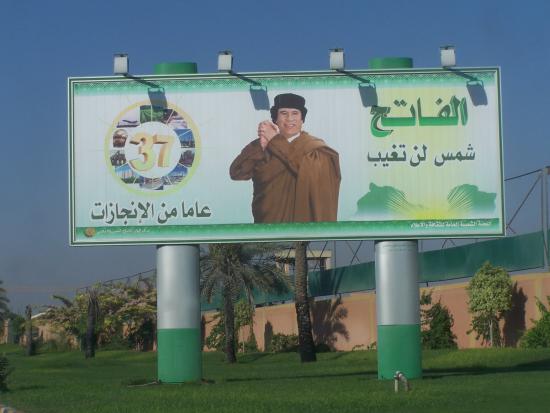
Billboards are everywhere, extolling the virtues of having 37 years of un-interrupted, thoughtful and insightful government. Direct sms / text messages are sent out through the two state owned mobile networks. There can be and some even are quite informative. They will tell you that Libya has just bough a new cargo ship, with the url to provide further reading, that there are a number of highly skilled and professional doctors visiting a particular clinic, to provide a whole range of interesting and particular services. Some messages will direct the discerning reader to the the home page o the leader himself, where his views on a whole range of subjects can e viewed ad nauseum. For those with an inquisitive mind, read on.
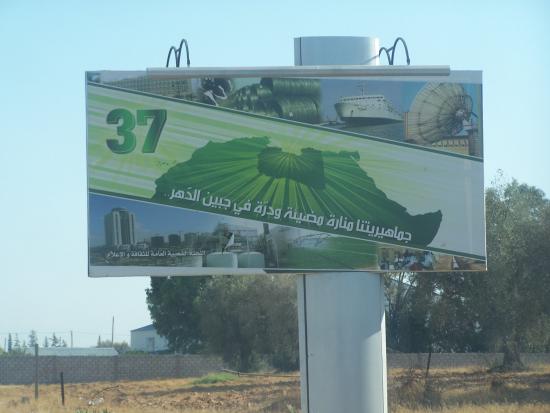
One of the local billboards
Oh yes, there are no end to the amount of ways in which the good Libyan can be reminded that theirs is a land of milk and honey [and remarkably tasty honey at that]. This brings me to another subject. Milk and Honey. Libya is, potentially, a hugely wealthy country. As part of the OPEC cartel on middle eastern oil prices, or as some may say, extortion; see here for a balanced and reasoned OPEC view about how alternative source of energy should be promoted.
Libya receives, and indeed has received, vast sums of money for the oil that lays not to far away from the surface of a vast dessert, which makes up around 70% of the land mass of this country. Libya however, imports around 80% of the food on which it relies. Given that it is mostly dessert, this may not be too surprising, one may think. Not until you understand where most of that food is actually important from. Tunisia, mostly sand and 20% of the size of Libya.
The UAE, almost all sand and 10% the size of Libya. Egypt, 70% the land area of Libya, seven time the population but still able to produce a food surplus and export to their hungry neighbour. Algeria, Turkey, Syria, Saudi. All, without exception, hot, sandy countries. All exporting food to Libya. Europe even exports food. The Danes are now not the artistic pariah’s they were, Italian coffee and ice cream are very popular [as are the Chinese knock off’s of most of the Series A football shirts] and often help pass the evening while discussing the virtues of a really good pomodoro sauce. I jest !!
Having said that, the food that they do produce is, as I have said before, really good. the fruit and vegetables are cheap, plentiful and, more importantly for me, seasonal. Grapes are not available all year round, nor are the the really good strawberries.
The melons are in plentiful supply for only a few months a year [June, July as it happens], I have a a cantaloupes here with me now, 1.5 Dinar for the melon, or, about £0.60. The bread too is exceptional, and, true to the [pseudo] socialist dogma of this unique democracy, is so cheap to be almost fee of charge.
A single dinar will buy around 6 croissants, a dozen soft white rolls and two large rounds of very brown and very nutty bread. And tomorrow you have to buy it all over again as it does not stay fresh for more than a day. Still, there are bakeries everywhere, so this is not really a problem.
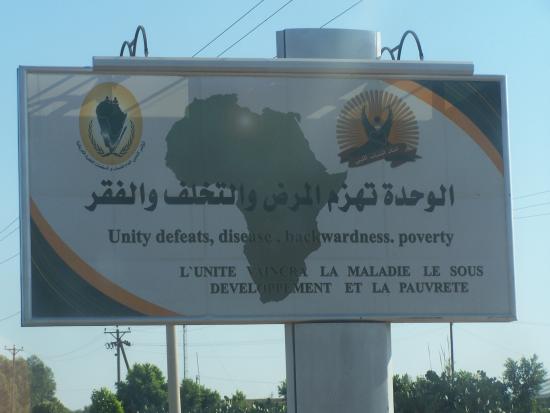
As far as home produced food in concerned, Libya has a very successful market garden economy in progress. All heavily subsidised so that even the poorest of Libyan society will have at least something to eat. And, despite the rhetoric espoused on the numerous billboards from the airport tp the city [work partners not wage slaves] there are some very poor people here. Very poor. The poorest of whom are, almost without exception, the black Africans, who, over successive generations and centuries, have seen this part of north Africa become and remain a muslim enclave, populated by the successors of the Berber arabs who pushed along the shores of this part Africa, filling the vacuum in part left by the departing Romans some 1600 years ago.
There is a vast population of black Africans, manual works, painters, plumbers, labourers etc, who advertise there skills every morning by sitting by the side of the road with there tools in hand, hoping that somebody will need a job doing today. Should they be lucky enough to gain eventful and, best of all, paid employment for the day, they will typically receive around 10 Dinar a day. Around £4.00. For ten Dinar per day, these people need a subsidised home produced market garden economy, producing a wide range of seasonal fruit and veg’.
But, I hear your cry, from the furthest and farther flung lands, surely Libya must make something of it’s own ? It must produce something ? National pride has to be focused on something ? After all, every country has it’s key export, the way in which it sends it message of cultural identity across the globe : Germany has it’s beir and wurst [and it’s Hamburger and apple pie], France has some really rather good cheese and when they can be bothered, can make a Renault stay in one piece for longer than it takes to pay for it, Ireland has it’s stout [a drink that a chap called Guinness first consumed in the back streets of London and was most favourably praised by the hotel porters after which it took it’s name : porter], Canada has it’s maple syrup and for those who really want to try it, elk stew, narwhal soup and the occasional seal on a stick.
The Scandinavian countries mostly their vodka and telephone equipment, Egypt has it’s miniature pyramids and stuffed toy camels and America has coke. And the funniest of television comedies of course ! Hmmmmmmmmm.
So, what is Libya’s rais en d’etre ? What is the cherry on the Libyan Bakewell, the Cadbury Dairy Milk in a kitchen full of Hershey bars ? Excluding oil, which is more luck than good management, sadly, there isn’t one. Libya produces and therefore exports nothing. Zilch, nada, diddly squat, nichts, bugger all. Vast container loads of European and Chinese goods arrive at least weekly, full to the brim with the highest quality Chinese plastic, end of date European food, last years fashion clothing and the occasional Korean car.
As most of you will know, Daewoo, the South Korean manufacturer of high quality automotive product was bankcrupt a couple for years ago and were in turn bought by General Motors and, under the Chevy brand [yes, Chevy, i kid you not.!!] have been re born. Libyan roads are now awash with high powered two litre Chevy powered four dour saloons, the incarnation of the Daewoo Nubira.
Daewoos have always been popular here. Well, maybe not ‘popular’, but there are lots of them. Lots. LOTS. The Libyan Government struck a deal a few years ago to buy several thousand of them and have them clog up the streets of Tripoli as badly driven taxi’s Judging by the amount of them that have dents in the wings, lights hanging out, twisted chassis’s and very blue smokey exhausts, this deal did not stretch as far as maintenance and spare parts.
However, I digress. Daewoo and Libya entered into a deal that saw the birth of the Libya car industry. Daewoo built a factory here. The ‘sold’ the design of the Daewoo Nubira and allowed Libya to build the popular automotive leviathan under license. And so, Lubja , The state owned Libya car industry was born.
There were two main flaws with this deal. One. The Daewoo Nubira is, without any shadow of a doubt, a truly awful car. There are not many cars that could be said to be worse that a Nubira, except of course everything with the word Proton on the boot. So the foundations for the Libyan car industry were, at best, built on shaky foundations. The second problem with the deal was that, frankly, the Libyans are not very good at building things, anything, and especially, as history will and has testified, cars.
The Libyan Government suggested that Daewoo pump more money into the project. Surely that would drive sales, from which Daewoo would get a return on the deal. Daewoo suggested that the Libyans should take a flying jump, Daewoo pulled out and the Libyan automotive dream, in fact their second automotive dream, was dead. Lubja’s can still be seen, occasionally, driving around Tripoli.
Naturally, only as taxi’s, and pretty beaten up taxis’s at that. But, ten years on, like a frisbee with to much duct tape on, they are still running, patched up, and a testament to the determination of a nation of very small people, 80% of whom are known as Kim, the re badged Deawoo Nubira keeps clogging up the roads..
End of part one.
 Mark Daniels