Originally on Friday, 18. January 2008.
Four months ago I arrived in Antananarivo, Madagascar.
Madagascar is classified as the planets fourth largest island. Not a particularly amazing statistic, in itself but, one should ask oneself, if you exclude Man, what is an island ? In simple terms, an island is simply a mass of land that is visible above sea level. Which means, that as we pump more and more crap into the atmosphere with the inexorable rise in temperatures around the year followed by the inevitable rise in sea levels from the ever decreasing ice sheets, Madagascar is in an ideal position to remain one of the largest islands.
Antananarivo, the capital, is around 4200 ft above sea level. Which gives it the strategic advantage over most cities in this part of the bottom of the planet. It is also this elevation that has caused me a few problems over the last few weeks. I have had more coughs and colds in the last two months, than I have had in the last few years. The thinner air, the variable temperature [warm to very hot] and the high levels of humidity have all contributed to a series of not serious, but annoying lingering ailments.
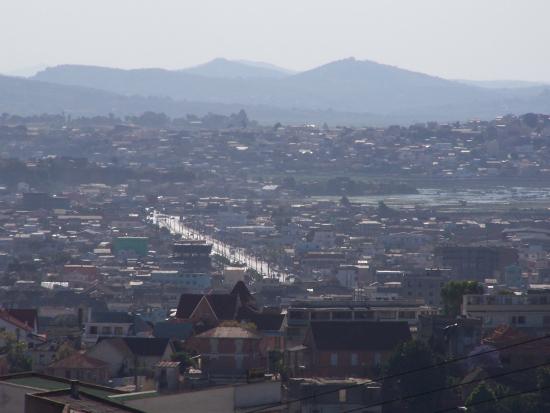
So, apart from the elevation, what else does Antananarivo, or Tana for short, have to offer?
Tana is an eclectic mix of colonial French and Malagasy cultures, with a fair chunk of Chinese, Malay and Philippine thrown in for good measure. Take food. Rice and noodles. A bowl of noodles, bought in the street, eaten there and then would be 1000 Ariary, which is about £0.25. Better than a Mars bar. If you want something a little less noodly there is an army of Malagasys touting their culinary wares on a seemingly permanent basis. Noodles, samosas, things that look like ‘spring rolls’, although they are not…… There are mangos, lychees, peaches, bananas and a whole bunch of deep fried finger food that is ony available in Malagasy. I did buy some ‘aubergine bignet’ which is essentially pieces of deep fried aubergine. Mmmmmm tasty. Except for the poulet stuffing. Oh. Chicken and aubergine deep fried.
There are so many Malagasy in ‘Tana selling food. For example, there are single item sellers, selling only, for example, salami. Actually, it is not really salami. It looks more like spam in a Salami shape. But spam without the meat. Actually, it doesn’t even look like spam. Not to far away there will be somebody selling bread, so you can make one of those funny French things, le sandwich. [Yes Yes, I know sandwiches are not French, they are part of the long line of culinary delights to emanate from England /ED] Move another ten or so yards and finish off lunch with a few lychees, or some mango / mangue all for less than 2500 Ariary, which is about £0.60.
Actually, you don’t even have to move. They will come to you. Even if you don’t want anything….. they will walk along with you trying to persuade you that a pepperami without the ‘ami’ is the most delicious thing you could ever possibly consume. This is not Keith Floyd and certainly no Nigella.
And for vegetarians ? Nope, not a sausage. Literally. Which, given the actual meat content of most things is surprising. But the Malagsy do love their meat. It is never beef, or pork, or lamb. It is just ‘meat’. Unless it is chicken of course. And they eat a lot of chickens. Which is convenient because there are a lot of chickens. Everywhere.
Walk down the street and there are chickens. Drive along the street and you are constantly waiting for the slight rise in the front offside wheel as you turn a chicken into a schnitzel with the easy application of a Nissan Patrol. But, to this day, I have not seen a single dead chicken. Not a road kill chicken anyway. I have seen a lot with a spit up it’s arse, being slowly roasted, but non stuck to the front of a taxi. As Richard Dawkins would correctly assert, chickens are evolving. They understand ‘cars hurt…..’ which, ironically, is more than some people have learnt, despite Tufty.
I digress.
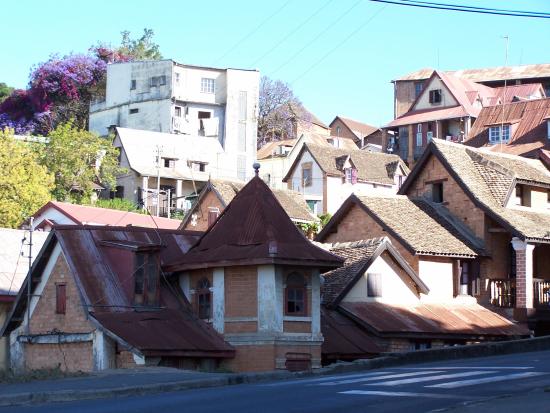
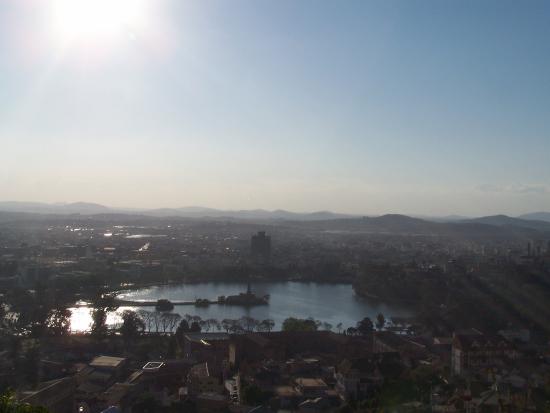
Tana is a pretty dirty city. Actually, pretty and dirty in equal measure. Like Rome it is a built on a series of hills which dominate the city scape. A long stroll up one or two of them will give the casual observer some excellent views of the French built city in the sky. There are small colonial style buildings dotted all along the side of the roads, often one on top of the other, sometimes, two on top of the other. Very tall and very narrow, probably a style taken from the initial building materials, long, thin and not very strong trees that do not span very far. This was even more evident the further south one drives through Madagascar.
There are also open culverts, or drains, everywhere. At some point in the past they have been covered with slabs of concrete but, as the traffic volumes grow ever larger and ever heavier, the concrete has broken and exposed the fresh running water taken directly from every building in the city.
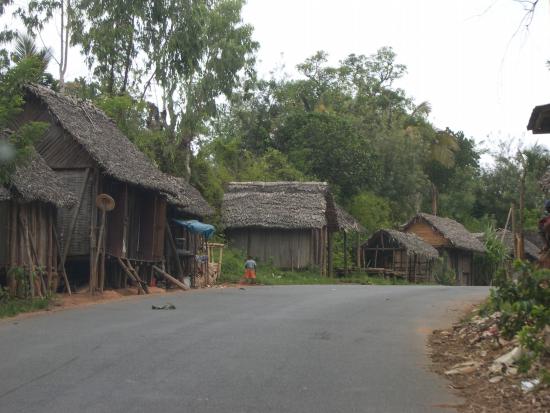
As one drives further south the architecture changes from brick and tile to wattle and daub walls with grass roofs. And they get smaller. Very small indeed. Ten foot by 12/14 foot for the entire house. In which six, seven or eight people may live, or at least sleep. There is also a a persistent and pervasive smell. Smells are hard tro describe and usually include reference to other smells. Like, ‘it smells of flowers’ or ‘it smells musty’ etcetera. So describing the smell is difficult. Instead, I’ll tell you how the smell is made.
The Malagasy burn anything and everything. All the time. The edge of the road is burning, smouldering. There are cooking pots by the roadside full of soup, sitting atop an open fire. Asterix would be proud. Fields, trees, rubbish; it all gets burnt. However, night time is the most productive for the pyrophile. As I said, the houses in the south are small houses, made of organic material. They are often black inside. Dark as well, as there are no windows, but actually black. Soot black. The Malagasy burn fires inside their small huts and as there are no chimney’s, the smoke simply fills the void and then permeates through the grass roof, giving the impression that the building itself is one large smouldering log.
There are probably some very good reasons for doing this. A source of heat probably is not one of them, but light almost certainly is, as there is little or no power supplied to most of the island. Heat for cooking certainly, but also, I’m guessing, this may be a way to keep the mosquitos, flys and other bugs out of the hut. Or maybe not. Maybe there is no better reason than simply ‘this is what we have always done……….’
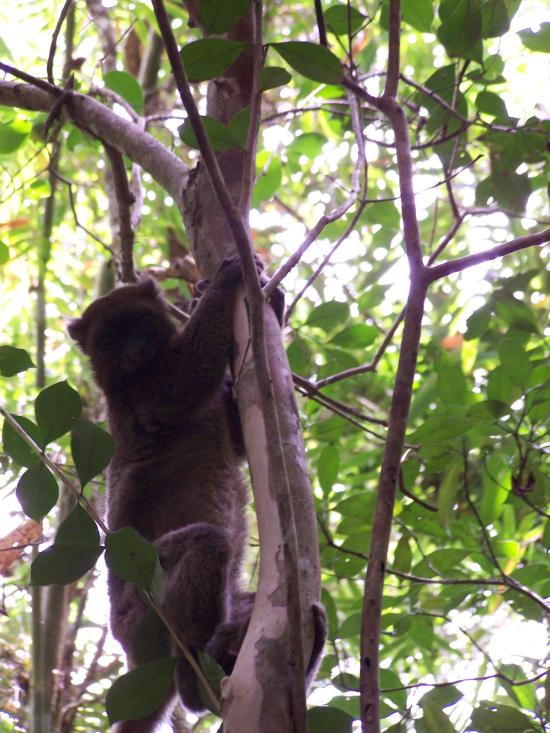
It is hard to talk about Madagascar without talking about the environment, ecology and all that stuff. As you will probably have read else where, Madagascar is home of many species of animals and plants that are found only here in Mada’. It is an oft’ stated fact that some 90% of Mada’s plants and animals appear only here on this island.
Madagascar split from India around 80 million years ago and since much of it’s plants and animals have followed an evolutionary path which has given the island the enviable status of holding so many unique species. Plate tectonics is, itself, an interesting science but one that we will not spend any time on here.
Evolution is an even more interesting science and for those who wish to learn more rad almost anything by Richard Dawkins. However, evolution built on the platform of plate tectonics has put Mada in a position where it is now desperatley poor, who’se infrastructure is many decades old and who’se natural resources are the very same unique species that make Mada’ such an interesting place.
So, what is Mada like, on the ground ? Utterly beautiful it has to be said. The landscape is wide, large. It has a feeling of old age. It is green, hilly and largely devastated. It is estimated that 90% of Mada’s ‘natural’ woodland has vanished in the last 50 years. Forests, some unique to the island are being torn, chopped and burned down to make way for rice fields and other arable crops. This is putting greater and greater pressure on the island to be both a modern, active and essentially developed location and, at the same time, somewhere that is a home to the countless fluffies who inhabit the ever decreasing woodlands.
Madagascar exports 80% of the worlds vanilla. It is self sufficient for most fruits, including bananas, melon and of course the delicious mangos. Milk products are expensive, partly because of their limited availability, due to a lack of horizontal grazing land, but mostly because of a lack of demand. The Malagasy just do not drink milk, eat cheese or use butter. And the certainly don’t make rice puddings.
However, there is a drive to have the Malagasy drink more milk and dairy products. And as the Pres’ owns Mada’s largest dairy company, there is an expansion of milk production on going, with the inevitable impact on the ground that you see everywhere are cows.
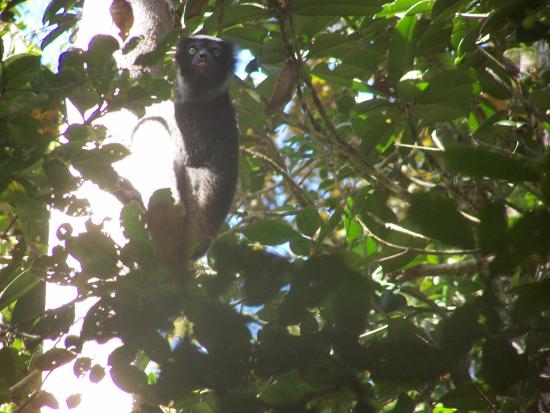
Madagascar is a beautiful place. But it is on the cusp. And, almost uniquely, it’s destiny is entirely in it’s own hands. It has to manage the balance between economic growth and prosperity and maintaining the unique ecology of an island so important in preserving too many of the worlds endangered species. Madagascar needs to understand there is a choice to be made between ‘ah, it’ll do….’ and ‘we have to do it better….’.
Oh, and no, the water does not spiral in the opposite direction in the southern hemisphere.
 Mark Daniels