Originally written on Friday, 23. February 2007.
This is the latest instalment from the English Epicureans occasional deranged ramble about good food, out and about.
Good food should not be the preserve of the high priced, swanky restaurant, the up market chic bijou eatery that has both a Maître d’ and a sommelier and where the menu has more adjectives than nouns. When you think about, a menu should be a list of the foods on it, not a one hundred word soliloquy of Mediterranean sunsets, but then again at the opposite end of the scale, it should not have pictures of the food the chef [or cook?] would like to prepare, if only had been to Chef school or knew what the phrase ‘health and safety’ meant.
No, good food should be taken anywhere, taken in small bites or great swathes of grazing, from paper wrappings or from the finest china. However, this occasional piece concentrates on the food that is eaten out of hand, when you just need that quick bite, when time is more important sometimes than dining etiquette*.
The is when you need to consume some food on the hoof. That food is usually the traditional or key dishes from the area, dishes using local ingredients, cooked using a little je ne se qua, with a little unknown spice, flavoured oil or with something almost entirely unknown on the side. It may be a plate of black olives with some fresh crusty bread and a little oil, or a slab of local cheese, deep friend and garnished with basil, but whatever the local speciality, they should all have one thing in common, they should all be good food.
So where is next hop on this culinary review of the greatest food on the hoof ? The home of the waltz, the Viennese whirl and countless cakes and pastries and some of the most amazing Baroque architecture.
Vienna or Wien in the native tongue, is perhaps a clue to one of the best known culinary exports; the wiener, wurst or, as our colonial cousins across the water call them, hotdogs. In Vienna, six inch long tubes of smoked meats and spices are called Frankfurters. Oddly enough in Frankfurt, they are called Wieners. Mutual appreciation indeed.
So lets get to it. Food on the hoof.
Vienna is a beautiful city. Really. It is still laid out in the old mediaeval plan of three concentric circles, radiating out from the centre by the river that splits the old city on one side from the new, more modern city on the other. it has so many wonderful little cafés, coffee shops, pubs and restaurants. The Viennese menu is truly wonderful.
There are veal Schnitzels, which, taken literally from the German, mean ‘slice’. There are wursts, or sausages, to make the mouth water and which fill the air with a wonderful grilled essence that simply has to be taken into be be truly appreciated. And then there are cakes, but we will come to those later.
But this is a eulogy about food that is eaten out of the hand, taken while mobile; food on the hoof. So what is the Vienesse culinary status for food that is taken vertically? Well, pretty good it has to be said. The Austrians, like the Germanic cousins to the north love to eat food out doors.
There are many semi permanent ‘markets’ where food is taken, enormous wursts in a bun, boiled or grilled onions on a paper plate, mashed potato with beef fat, in German this is called ‘schpeck’, all washed down with lashings of wiessbier or locally made red or white ‘gluwien’, made from apples. All amazing stuff.
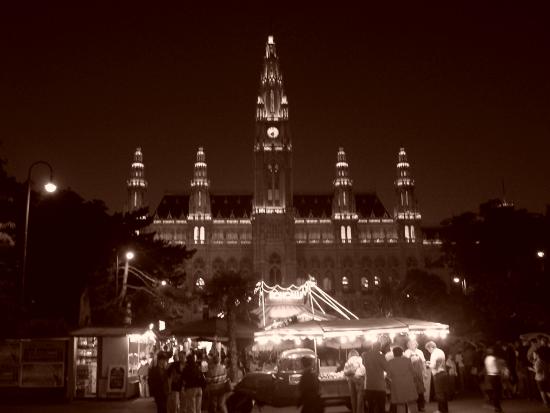
Part of what makes this such a wonderful dining experience is the atmosphere. Lots of people int he same place with one thing in mind, eating good, hot food, in the cold outdoors, sharing an A frame bench with others there for the same reason, squeezing between large, round Teutonic men with a beer in one hand a meal in the other. The other thing that makes this such a great way to eat is the smell. The smell can only be experienced to be really appreciated. grilled wurst smoke wafting around the place, different types of sausages, the onions, grilled fish or shrimp and the frying of doughnuts.
Another delicacy that the Austrians, and indeed the dear Vienesse, are the pretzels. Pretzels are a Germany delicacy rather than Austrian but they are consumed in the streets of Vienna in vasts quantities. They are not the small, hard snacks that are produced in industrial quantities, but are large, baked fresh pretzels. They are around ten inches across and are often baked in the shop that is selling them. They are for sale in shops, in cafés, railway stations, in fact, just about anywhere that there may be somebody with a grumbling stomach, there are fresh pretzels and gluwien for sale. And again, they are delicious.
So what of the cakes ? Vienna is the home to some amazing cakes, the most famous of these being the Sacher Torte, or Sachertorte, from the Sacher Hotel. It was invented by Franz Sacher in 1832 and has been in demand pretty much ever since. And why not. Look at the ingredients : pure chocolate, butter, eggs, sugar, flour, almonds and apricot jam, all topped off with a cooked chocolate icing. It is , frankly, amazing.
But there are so many more you can try in Vienna : Vanillekipferl (sweet vanilla-hazlenut biscuits); Topfenstrudel (a cream cheese strudel); Palatschinke (a Viennese crêpe, from the Hungarian palacsinta); Powidl ;Buchteln (yeast and butter bakery filled with apricot jam)and of course, my absolute all time favourite, the Apfelstrudel, which is a heavy apple pastry, with cinnamon, dried fruit and dried fruit skins and of course, marzipan, very much like the German Stollen.
And the Vienesse food on the hoof rating;
out of ten.
* Even when eating food on the hoof, there is still a dining etiquette. Napkins are still napkins, not serviettes, the cutlery maybe plastic, but a knife is still not a fork, and you always, without exception, always avoid anything with the prefix Mc.
Oh and the Danish pastry is said to originate from Vienna and in Denmark is called wienerbrød (Viennese bread).
 Mark Daniels